

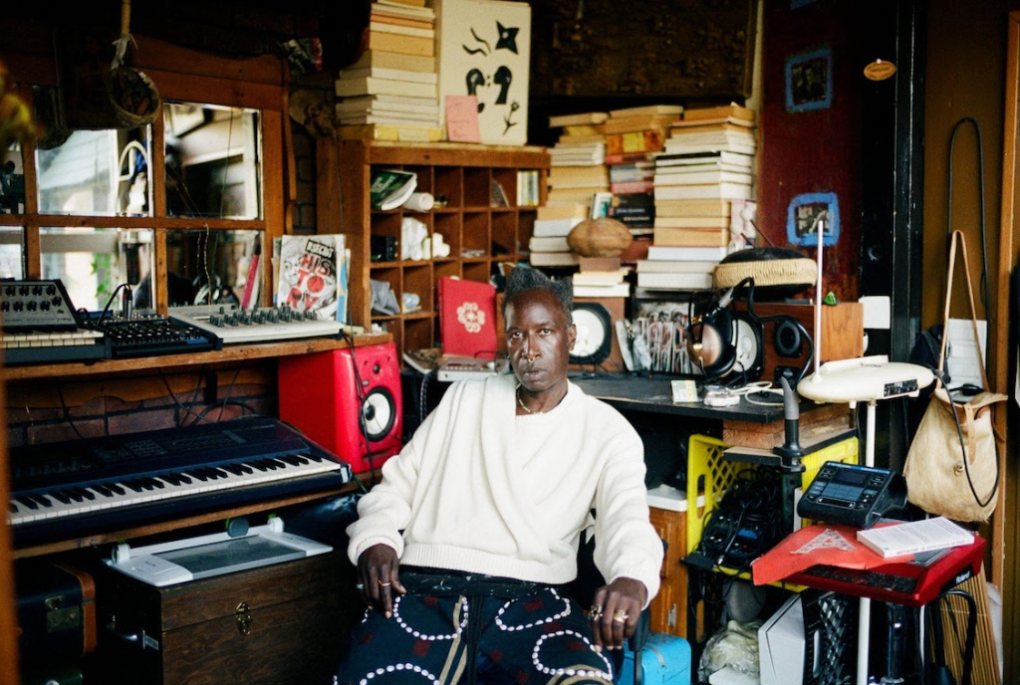
Saul Williams announces his new album, LeapLife (Big Dada), out August 28th, and in conjunction releases the lead single/video, “Conspiracy.” Named after his leap year birthday, LeapLife arrives less like a conventional studio record and more like an invocation assembled in real time — a gathering of spirits, histories, frequencies and unfinished revolutions arranged through voice, rhythm, and intuition.
It marks his first solo full-length work in seven years, and a return to the label where he originally released his first solo works – 1998’s “Twice The First Time” and “Elohim (1972).” Today’s single “Conspiracy,” which features Gonjasufi and MoorMother, arrives alongside an official music video from director CleonArrey, whose previous credits include work with artists like Snoop Dogg, Akeem-Ali and A$AP Rocky. LeapLife also includes notable contributions and collaborations from the likes of Carlos Niño, Robert Del Naja (Massive Attack), Kamasi Washington, Georgia Anne Muldrow, and Surya Botofasina.
For nearly three decades, Saul Williams has occupied a singular place in Black Culture, resisting the confines of genre across music, literature, and film with almost militant consistency to use art as a transformative device. His extensive acting portfolio features performances in acclaimed films such as Sinners—which earned a record-breaking 16 Academy Award nominations—as well as Lackawanna Blues, Aujourd’hui–TEY, and New York, I Love You. Additionally, Williams co-wrote and starred in the Sundance and Cannes award-winning film SLAM and recently marked his directorial debut with the feature Neptune Frost. Beyond the screen, Williams recently debuted his first graphic novel, Martyr Loser King. This multidisciplinary project integrates components from a touring dance production called The Motherboard Suite (made in collaboration with Bill T. Jones), a poetry collection, and three of his studio albums, including the titular LP.
With Leap Life, Williams expands the definition of what music itself can be, operating on the philosophy that “the voice is the instrument.” Throughout the album, Williams speaks, chants, improvises, and testifies over fluid arrangements that blur the lines between spoken word, jazz abstraction, hip-hop cadence, West African rhythmic logic, ambient composition, and ceremonial sound design. Moving beyond traditional rhyme structures, the project embraces spontaneity, treating language as a rhythmic, vibrating force while capturing the essence of a jazz improviser chasing revelation in real-time, reflecting a lifetime of artistic preparation.
It’s a risky process — surrendering control inside a medium built on permanence — but Williams sees revelation in that uncertainty. “What does it mean to trust the moment?” he asks.
That question echoes throughout Leap Life, an album focused on alignment: between the visible and invisible worlds, between living people and ancestral memory, between political struggle and endurance. Williams describes Leap Life as deeply informed by ideas of ceremony and shamanism. Not in the commodified Western sense of spirituality-as-aesthetic, but in the older understanding of music as a tool capable of carrying grief, resistance, and healing simultaneously. Where contemporary culture often rewards distraction and emotional numbness, Leap Life insists on intention and meaning.
The album operates almost like a carefully assembled spell, designed to evoke emotional movement within the listener. Nowhere is that clearer than in the album’s recurring relationship to ancestry and martyrdom.
Williams openly describes the record as an attempt to commune with the dead. Watching the ongoing devastation across Palestine, Sudan, Haiti, Congo and Yemen, Williams found himself wrestling with questions about what happens to collective grief, where the energy of murdered people goes, how the living remain accountable to the dead, and whether liberation movements require solidarity as much as political strategy. “We’re going to need those spirits,” he says. “There’s an understanding that the soldiers in our struggle are not only the visible ones. There are people standing and fighting with us that we may not see.”
That tension between accessibility and experimentation has defined Williams’ career. He remains deeply interested in popular music while interrogating its limitations. “I’m either inspired or disgusted,” he says with a laugh.
Still, Leap Life never feels cynical. Much of that balance comes through the album’s collaborative foundation with producer Carlos Niño, whose decades-long friendship with Williams stretches back to the late ’90s, when Niño first invited the young poet to perform in Los Angeles. Though Williams composed much of the music, Niño helped shape the connective tissue between disparate ideas, contributing arrangements and musical direction across songs like “Baobab Constellation,” “Great, Great-Grandmother,” “13 Moons,” and “Coming Forth.”
Also significant to the album’s coalescence is the work of Robert Del Naja (Massive Attack), who helped shape the sound of three Leap Life songs: “I Think I Get It Now,” “Controlled Is Not Controllable,” and “Not Everything For Sale.”
Equally intimate and cosmic, Leap Life invites us to slow down and notice what’s in front of us, and, most importantly, to see music as a weapon of change.



Social Media