

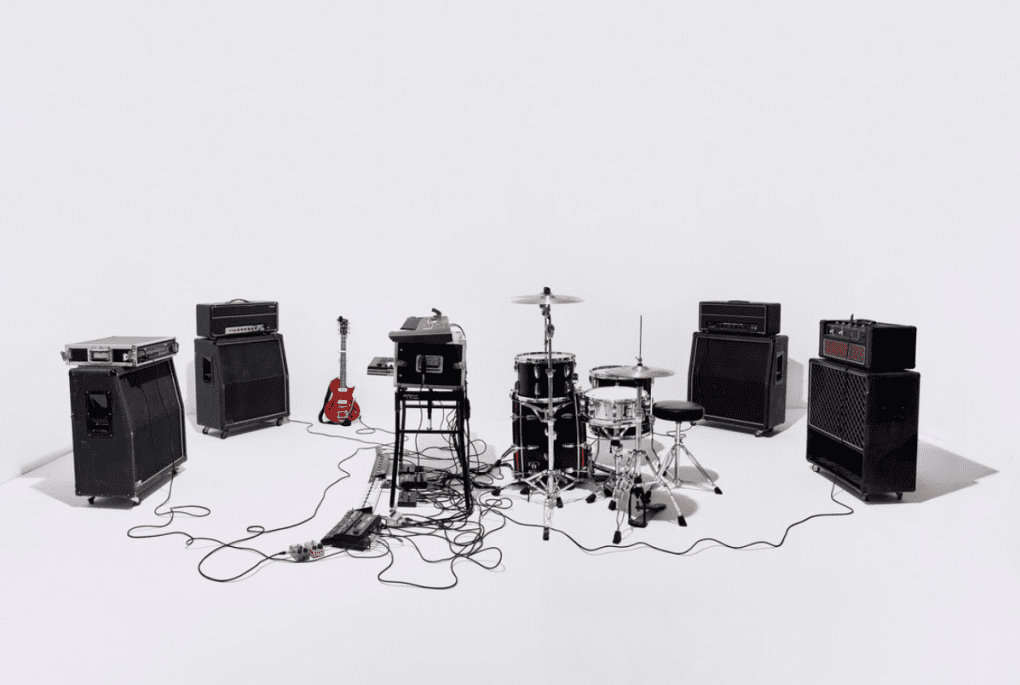
Chevreuil, the French rock duo of Julien F. and Tony C., formed in 1998 after the two met three years earlier at an Art School in Nantes. From the beginning, they approached the idea of a band as a performative art installation — a self-contained, sculptural device for sound, space, and motion rather than a conventional rock ensemble. Julien and Tony, respectively, in their parlance, play “magnetic drums” and “magnetic guitar,” an analogy for their livewire, one-on-one chemistry, where the music seems to fall together by way of natural forces. Today, the band shares its new single “Tartarus,” off its forthcoming full-length release.
Rejecting the addition of a bassist early on, Chevreuil built its music around reduction, repetition, and architecture. Tony’s guitar runs through four amplifiers arranged around Julien’s drum kit, creating a quadraphonic field that surrounds the players. Julien’s 1976 Ludwig kit — built the same year both musicians were born — is never amplified, allowing the group to perform anywhere so long as there’s a single outlet for the amplifiers. The result is both physical and spatial — a minimalist engine of rhythm and resonance that behaves as much like an installation as a band. Their sound construction operates like an assemblage of interlocking blocks of energy, each part locking precisely into the next. Between 1998 and 2006, Chevreuil released four albums, an EP, and several singles.
After a 20-year hiatus, Chevreuil returns with the double album Stadium (Computer Students™), recorded in France in January 2025 and slated for release on April 24, 2026. The project began as a plan to reissue their early work, but quickly evolved into a new entity. Having not played together for 15 years, the duo spent a week together testing whether their long-dormant chemistry could still function. By day they recorded; by night, they cooked for each other, rekindling the ease and discipline that defined their partnership. Julien’s decision to resume drumming was partly inspired by watching his teenage son struggle and persist through his first drum lessons — a moment that reignited his own desire to engage with the instrument’s physical language.
Stadium, Chevreuil’s most esoteric album to date, preserves the essential conditions of their earlier work—live recording, unamplified drums, and four-amp immersion—while introducing new elements that expand the duo’s sonic vocabulary. Central to this evolution is a reconfigured guitar, functioning as a hybrid electro-acoustic engine capable of generating electronic timbres without compromising the project’s self-contained design. Conceptually, the album draws on the music of the spheres, magnetism, radioactivity, barometric oscillations, astrometry and magic, using these ideas as lenses for exploring vibration and transformation. Each side of the double LP contains four pieces, forming parallel sequences that can be heard as two separate albums or a single continuum. The recording process remained constant — identical settings from tracking through mastering — so every variation arises solely from the nuance of performance.
Chevreuil’s return with Stadium reasserts their place in their lineage: a duo grounded in art-school conceptualism, sonic architecture, and human connection, building an environment of sound that is at once precise, raw, and alive.




Social Media