

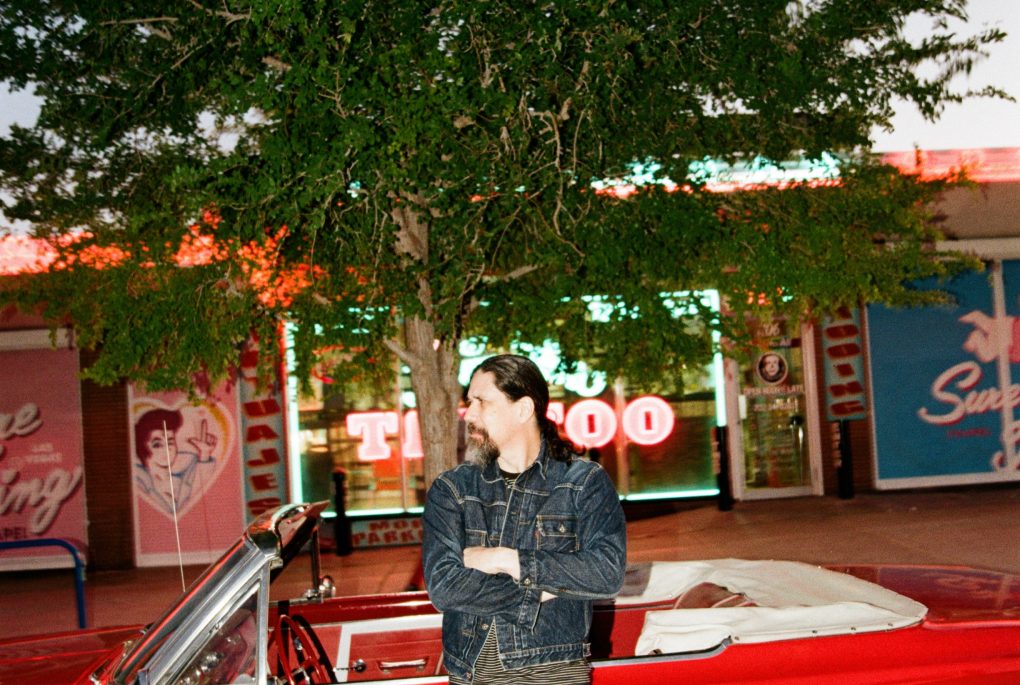
For nearly twenty years, Ted Sablay has helped bring some of modern rock’s biggest songs to audiences around the world. Since joining The Killers as a touring guitarist in 2006 (and serving as the band’s Musical Director since 2022), he has spent thousands of nights inside songs that have become part of people’s lives. It is a rare education for a songwriter. Somewhere along the way, that experience quietly changed the questions he was asking of himself. His new album, State & Motion, is the answer. “This is not ‘The Killers’ sideman finally speaks’,” says Sablay. “Rather, this record is, fundamentally, about the difference between bearing something and choosing something.”
State & Motion is a guitar-driven American rock record that lands squarely in the lineage of Petty, Jackson Browne, and The War on Drugs, and holds its own there. Ten songs, thirty-eight minutes. Heartland bones, power-pop hooks, no fat. Yet, ‘Heartland Rock’ tends to be written from the outside in; the emotion arrives by implication, through what the camera is pointed at. Sablay inverts the paradigm. The drama here is psychological. The line “I knew the price and bought it anyway” isn’t a scene. It’s an admission. State & Motion keeps the sound of the lane and abandons its lyric habits.
Today, Sablay shares the single off of State & Motion titled “For You.” Regarding the song, Sablay said, “The villain on “State & Motion” isn’t a person. It’s an instinct—the one to stay guarded. In the song “For You,” the narrator stops prying open the door and hands over the keys. Except he wants something back. He wants her to put down the martyrdom and pick herself up. Is that too much or the least of what he should ask of someone he believes in? Does he have the right to ask if he can’t hold himself to it? “For You” is the barest song on the record because, after a while, there’s nothing else to guard.”
Drummer Pete Thomas (four decades with Elvis Costello & the Attractions) plays across the record, alongside bassist Whynot Jansveld of The Wallflowers. The guitars work the way Keith Richards taught everyone they could: weaving parts rather than stacking, rhythm doing melodic labor, nobody soloing over anybody. Every song was written to survive being played alone on an acoustic guitar. That was the test. Nothing here needs the production to work.
Rather than rushing to follow his 2022 solo debut You’ll Be Back Here Soon, Sablay spent the next four years dismantling and rebuilding his songwriting from the inside out. The songs on You’ll Be Back Here Soon connected. People cared. But living with the record left Sablay thinking less about what he had accomplished than about what remained possible. Good songs, he realized, could always become better songs. “I wanted songs that weren’t contingent on your liking me,” he says.
In 2008, two years into the Killers gig, Sablay left touring to enroll at the University of Utah and study the sciences. While there, he took a job coordinating research for infectious disease physicians. He assembled literature reviews, studying foundational knowledge before attempting to contribute something new. In 2012, he went back to the band for four more world tours. But the method stayed with him. If poets, playwrights, novelists, and screenwriters had devoted lifetimes to understanding how language creates meaning, why shouldn’t a songwriter learn from them?
He began reading differently. Listening differently. Revising differently.
The romantic mythology that songs simply arrive, fully formed, had never held much appeal for Sablay. Instead, he became fascinated by the craft itself: structure, image, narrative, rhythm. The subtle difference between explaining an emotion and allowing a listener to experience it. Drafts became rewrites. Rewrites became complete reconstructions. “I studied how poets worked. How screenwriters worked. I wanted to understand it more deeply.”
Sablay begins with music, not words. A melody. Harmonic movement. A rhythmic feel. Small recurring motifs that quietly give a song its internal logic. Lyrics undergo months of revision as he searches for language that slides into the puzzle seamlessly. “I wanted these songs to have a sense of inevitability about them,” he explains.
Sablay hired for instinct rather than obedience, and then, characteristically, refused to stop. After receiving new performances from his collaborators, he often replayed his own parts until every interaction served the song as completely as possible. “It might only get five percent better,” he says. “But maybe that five percent matters.”
That quiet refusal to accept “good enough” may be the thread connecting every part of Sablay’s career. Whether teaching songwriting to students around the world, standing on arena stages night after night, or sitting alone rewriting a verse for the fifteenth time, he returns to the same question: not whether something works, but whether it says exactly what it means to say.
State & Motion is the fullest expression of that pursuit so far. It values directness over spectacle, emotional precision over performance, and craftsmanship over excess. Its concerns are deeply personal without ever becoming private.
Everyone grapples with what it means to be reliable, productive, and capable, even if only subconsciously. These songs are a melodic head nod to the quiet work we all do as we move through life, shouldering the burden of daily reality. State & Motion is a record that you’ll fall for — even if you don’t know Ted — because these songs tell the truth with enough care that, for a moment, they sound a little like your own life.
Photo Courtesy: Ashley Marie Myers







Social Media